Chinese EV Workshop Diagnostics: Check Access First
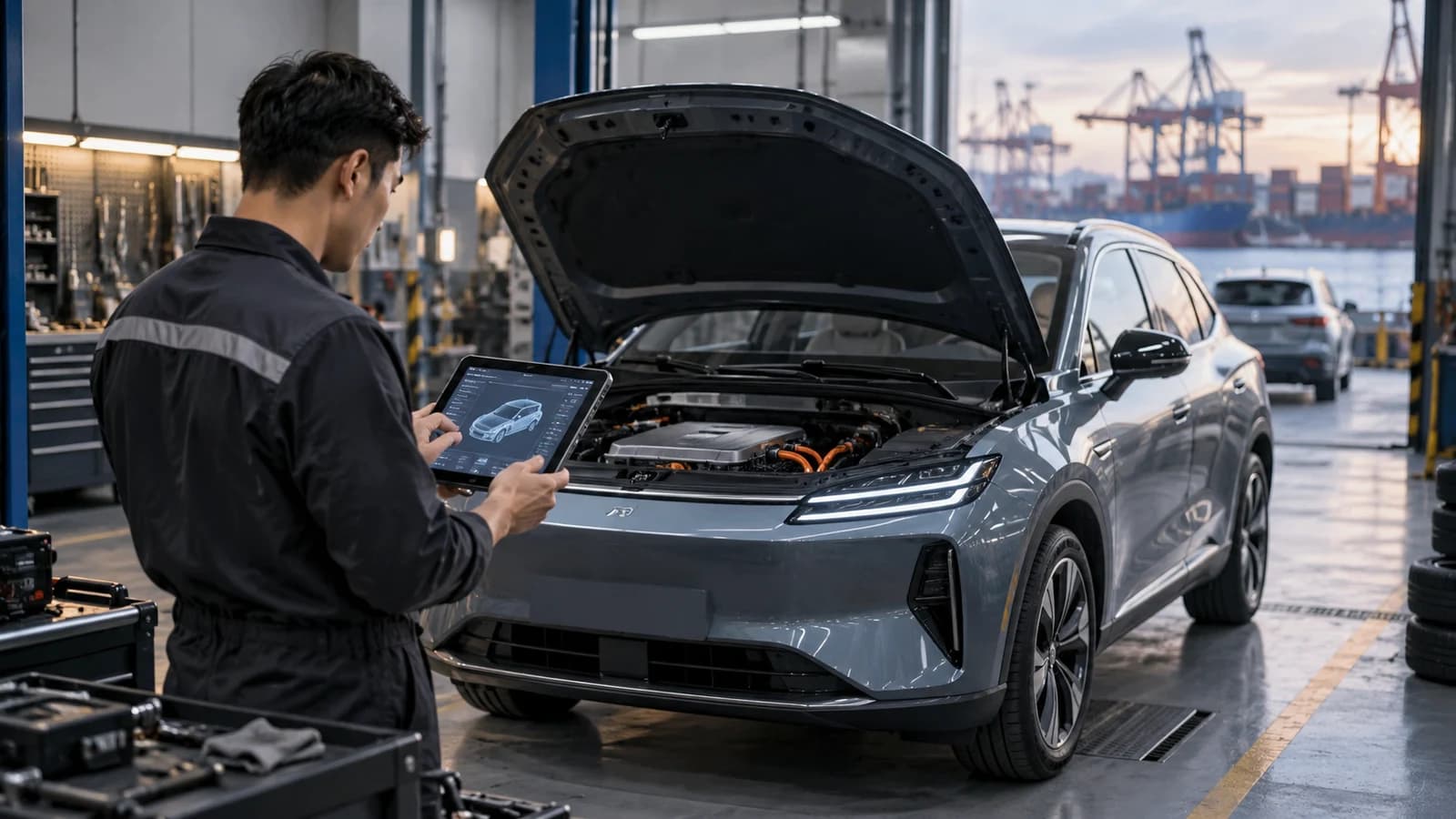
Direct answer. Confirm that a destination workshop can lawfully and competently diagnose the exact Chinese EV before buying it. Ask about manufacturer information, supported tools, authorized system access and escalation limits. A workshop that repairs local EVs or owns a generic scanner does not automatically support every Chinese-market configuration after export.
Key takeaways
- Identify the actual model, configuration and known condition.
- Ask the workshop to state its supported diagnostic scope.
- Verify dependencies on parts, software and authorized accounts.
- Keep sensitive access information out of general procurement records.
- Distinguish fault diagnosis from warranty or repair authorization.
Define the support task before asking for a quote
Describe the routine ownership support you need and any known issue already identified. A pre-purchase condition check, a warning investigation and a repair can require different capabilities. Ask the workshop which task it accepts rather than asking whether it works on Chinese cars generally.
Provide the vehicle identity and relevant configuration through authorized channels. A familiar model name can conceal a market-version difference. Have the workshop explain which information it needs to establish compatibility with the actual car.
If the vehicle has a suspected safety issue, share accurate authorized findings and obtain competent direction before movement or operation. Do not book an ordinary service appointment while withholding a condition that affects the workshop's ability to accept the vehicle safely.
Ask how the workshop obtains its information
The provider should identify the applicable manufacturer or other authorized technical information it uses. Ask whether access is current and whether it covers the imported configuration. An old document for a similar vehicle is not equivalent to the relevant supported information.
Clarify tool and software support with the competent provider. This article does not recommend devices, security bypasses or programming procedures. A successful generic code read may not establish the ability to investigate every relevant subsystem or perform an authorized repair.
Ask what depends on a manufacturer account, subscription, remote assistance or origin-side provider. Those dependencies can affect appointment timing and the support route. Keep unavailable access visible rather than accepting an assurance that the workshop will find a workaround later.
Create a diagnostic capability matrix
| Workstream | Provider confirmation |
|---|---|
| Vehicle identification | Exact supported configuration |
| Technical information | Applicable authorized source and scope |
| Tools and access | Supported route for the accepted task |
| Safety boundary | Work refused or referred to specialists |
| Repair dependencies | Parts, authorization and verification requirements |
| Escalation | Named contact for work outside the local scope |
The matrix should describe the provider's actual capability, not a list of desirable functions. Label a service as unverified until the workshop confirms it. Preserve the date because access and commercial arrangements can change.
Protect access and owner information
Ask what owner documentation and consent the workshop needs for authorized work. Give it the required evidence through the supported process. Do not circulate full credentials or access tokens in an ordinary purchase spreadsheet or ask staff to use a previous owner's account.
If the workshop proposes remote support, clarify the involved parties, approved task and relevant information handling. Qualified jurisdiction-specific advice may be needed for material privacy or contractual questions. A broad claim that remote diagnosis is convenient does not settle those obligations.
Keep diagnostic findings separate from account secrets. The ownership record needs the result, method and limitations; it does not need to expose the means of accessing sensitive systems. Arrange secure retention and removal through the appropriate provider process.
Separate diagnosis from repair and warranty
A workshop may be able to observe a condition but lack parts, authorization or the supported procedure to repair it. Ask for that distinction explicitly. A fault finding should not be turned into a promise of an immediate complete repair.
Check who authorizes work and who confirms the final result. If a warranty provider is involved, obtain its applicable process and terms for the exported vehicle. Do not assume that a local workshop's invoice will automatically be reimbursed or recognized by the origin seller.
Request indicative lead times with dependencies clearly stated. An estimate based on available parts and system access should be revised if either condition changes. The buyer needs a realistic support route, not an unconditional turnaround claim based on another market's service experience.
Test the support route through a bounded first appointment
Where appropriate, arrange an authorized initial assessment with a written scope. Record what the provider could verify and what it could not. A useful report leaves no ambiguity about work outside its competence rather than broadly declaring the vehicle fully supported.
General maintenance guidance is background, not proof of local diagnostic capability. NHTSA's EV safety information similarly does not authorize a workshop to handle every imported configuration. The decisive evidence is the provider's confirmed scope and the applicable vehicle-specific support route.
Use the spare-parts and service guide to map the ownership network and the export warranty checklist to examine commercial promises. Resolve the diagnostic-access question before the purchase becomes dependent on a provider that cannot accept the task.
Reconfirm access before an important booking
Contact the workshop when a material task is planned, particularly if its earlier confirmation depended on a subscription or remote partner. Ask whether the accepted scope and dependencies remain current. If the provider's access has changed, obtain the revised route before moving the car or authorizing work. Record the difference without portraying a previously truthful statement as a permanent guarantee. A current capability check helps the owner distinguish an inconvenient appointment delay from the more serious problem of having no supported diagnostic route.
Frequently asked questions
Does a generic scanner prove complete diagnostic support?
No. Ask the workshop to confirm the actual supported tasks, information, tools and authorized access for the vehicle.
Does a diagnosis guarantee the workshop can repair the issue?
No. Repair can require separate parts, authorization and verification. Keep those dependencies explicit.
Will an origin warranty automatically pay a destination workshop?
Do not assume so. Obtain the applicable warranty process and provider confirmation before authorizing work on that basis.
Sources
- U.S. DOE: electric vehicle maintenance — general technical support context.
- NHTSA: electric and hybrid vehicles — general safety context, not workshop authorization.